

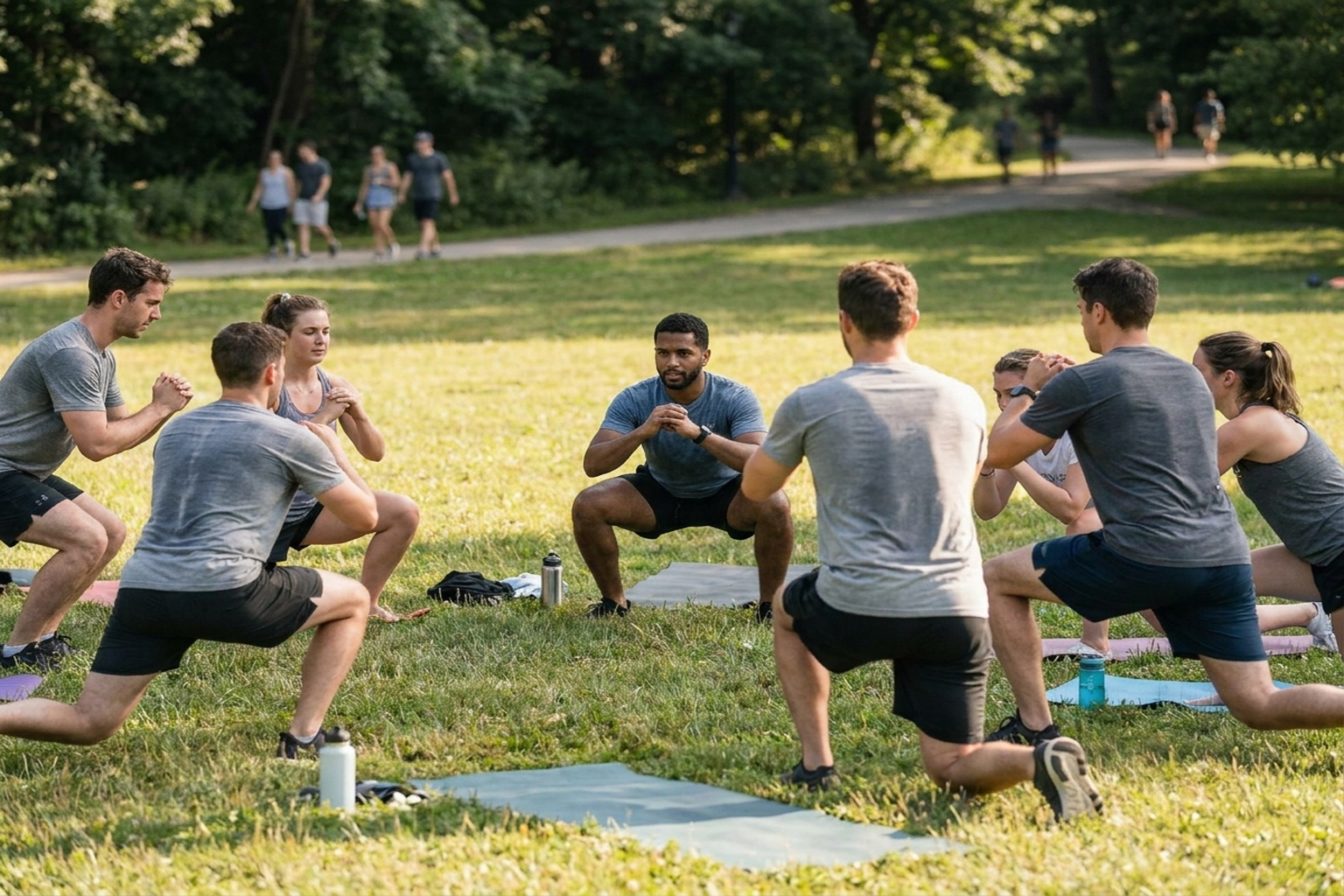
Twenty minutes. No dumbbells, no gym parking lot, no waiting for the squat rack. Just you, some floor space, and a timer counting down. That’s the entire pitch behind HIIT training, and it’s a pitch that actually holds up once you try it.
High-intensity interval training works by alternating short bursts of hard effort with brief recovery periods, and it’s built around a simple trade-off: you sacrifice duration for intensity. Instead of jogging at a steady pace for 45 minutes, you push close to your limit for 30 or 40 seconds, catch your breath, and go again. The workout ends before boredom has a chance to set in.
What’s kept HIIT training relevant, rather than just another fitness fad that faded out, is how little it demands logistically. You don’t need equipment, a membership, or a block of free time in the middle of your day. A spare room and a willingness to work hard for short stretches is enough.
What Is HIIT Training?
HIIT training, or high-intensity interval training, is a workout method that alternates short bursts of near-maximal effort with periods of rest or lower-intensity movement. A typical interval might be 30 seconds of all-out effort followed by 30 seconds of rest, repeated for several rounds.
The core idea is simple: push hard, recover briefly, repeat. That contrast is what makes HIIT training different from steady-state cardio, where you keep a consistent pace for the whole session — think a 30-minute jog at the same speed the entire time.
Because the “work” portions are so intense, HIIT workouts tend to be short. Most sessions run somewhere between 10 and 30 minutes, which is one of the biggest reasons people are drawn to this style of training in the first place.
How HIIT Training Works
The logic behind HIIT training comes down to intensity and recovery working together. During the high-intensity intervals, your body relies heavily on anaerobic energy systems — the ones that don’t need a steady oxygen supply to produce quick bursts of power. During the rest periods, your heart rate comes back down slightly and your muscles get a short window to recover before the next round.
This on-off pattern lets you sustain a level of effort that would be impossible to hold for a long, continuous session. You genuinely couldn’t sprint for 20 straight minutes, but you can sprint for 30 seconds, rest for 30 seconds, and repeat that cycle many times over.
A HIIT workout routine usually has a few core building blocks:
- Work interval – the hard effort portion, often 20–60 seconds
- Rest interval – a lower-intensity or complete rest period, usually similar in length to the work interval, sometimes shorter for more advanced training
- Rounds – how many times you repeat the work/rest cycle
- Circuits – groups of different exercises performed in sequence, often repeated for multiple rounds
You can mix and match these elements depending on your fitness level, which is part of what makes HIIT training so adaptable for beginners and experienced exercisers alike.
Benefits of HIIT Training
People stick with HIIT training for a mix of practical and physical reasons. A few worth highlighting:
- Time efficiency. A solid HIIT workout can be done in 20 minutes or less, which matters a lot if your schedule is tight.
- No equipment required. Bodyweight HIIT training at home is completely doable — your own body provides plenty of resistance.
- Cardiovascular and muscular engagement. Because HIIT combines short bursts of effort with brief recovery, it challenges both your heart and your muscles in the same session.
- Variety. With so many exercises to choose from, it’s easy to avoid the boredom that comes with doing the same cardio routine every day.
- Scalability. HIIT training at home can be as gentle or as demanding as you need it to be, which makes it useful for beginners and more advanced exercisers.
It’s worth being upfront here: individual results from any workout program depend on a lot of variables — nutrition, sleep, consistency, starting fitness level, and overall lifestyle all play a role. HIIT training isn’t a guaranteed fix for weight loss or a specific fitness goal, but it can be a useful and efficient part of a broader routine.
Best HIIT Exercises for Beginners (No Equipment Needed)
One of the best things about HIIT training at home is that you don’t need a single piece of equipment to get a genuinely challenging workout. Bodyweight movements are more than enough, especially when you’re just starting out. Here are some solid beginner-friendly options:
- Jumping jacks – a simple full-body warm-up move that gets your heart rate up quickly
- Bodyweight squats – works the legs and glutes without any added load
- Modified mountain climbers – a slower-paced version that still challenges your core and shoulders
- Step-back lunges – gentler on the knees than jump lunges, good for beginners
- Wall push-ups or knee push-ups – builds upper body strength without full push-up demands
- High knees (marching pace for beginners) – raises heart rate while staying low impact
- Glute bridges – targets the posterior chain with minimal joint stress
- Standing bicycle crunches – works the core without lying on the floor
If you’re looking for a low impact HIIT workout — useful if you have joint sensitivity, are returning from injury, or just prefer to keep things gentler on your body — swap high-impact moves like jumping jacks or mountain climbers for their low-impact versions: marching in place, standing knee raises, or slow step-touches instead of jumps.
A Simple HIIT Workout for Beginners (20-Minute HIIT Workout)
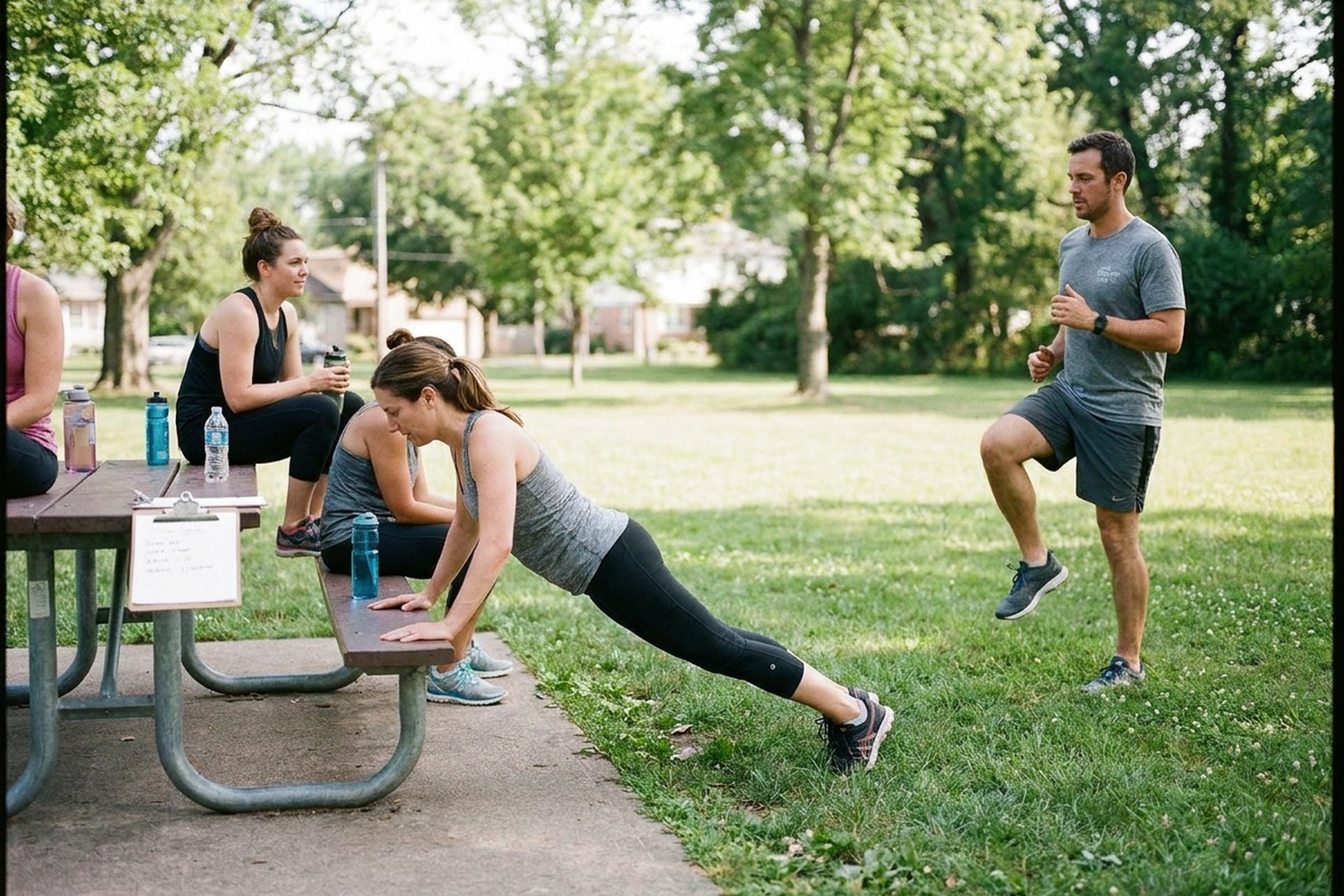
Here’s a straightforward 20-minute HIIT workout you can do at home with zero equipment. It’s built around a 40 seconds work / 20 seconds rest structure, which tends to be manageable for people newer to interval training.
Warm-up (3–5 minutes): light marching in place, arm circles, bodyweight squats at a slow pace, gentle torso twists.
Main circuit (repeat 3 times through, resting 1 minute between rounds):
- Jumping jacks (or low-impact step-jacks) – 40 seconds work, 20 seconds rest
- Bodyweight squats – 40 seconds work, 20 seconds rest
- Modified mountain climbers – 40 seconds work, 20 seconds rest
- Step-back lunges (alternating legs) – 40 seconds work, 20 seconds rest
- Wall or knee push-ups – 40 seconds work, 20 seconds rest
- Standing bicycle crunches – 40 seconds work, 20 seconds rest
Cooldown (3–5 minutes): slow walking in place, hamstring and quad stretches, deep breathing.
That’s a complete HIIT training at home session, and it hits legs, core, and upper body without needing a single dumbbell.
Intermediate and Advanced HIIT Workout Ideas
Once the beginner version starts to feel manageable, you can progress a HIIT workout routine in a few different ways without needing a gym:
- Shorten the rest periods. Move from 40/20 to a 40 seconds work / 15 seconds rest structure.
- Add impact. Swap step-back lunges for jump lunges, or bodyweight squats for jump squats.
- Increase rounds. Go from 3 rounds to 4 or 5.
- Add tempo changes. Try 20 seconds of maximum effort followed by 10 seconds of rest (a classic Tabata-style structure), repeated for 8 rounds on a single exercise before moving to the next.
- Combine movements. Pair a squat with an overhead reach, or a lunge with a twist, to challenge coordination as well as intensity.
Progression should be gradual. Jumping straight into advanced HIIT training before your body is ready increases the risk of poor form and injury, which defeats the purpose of a workout meant to make you feel stronger, not sidelined.
Here’s how a typical structure shifts as you progress:
| Element | Beginner | Intermediate/Advanced |
|---|---|---|
| Work interval | 30–40 seconds | 20–45 seconds (variable, higher intensity) |
| Rest interval | 20–30 seconds | 10–15 seconds |
| Rounds per circuit | 2–3 | 4–5+ |
| Impact level | Low to moderate (marching, step-back lunges) | Higher impact options (jump squats, jump lunges) |
| Total session length | 15–20 minutes | 20–30 minutes |
| Weekly frequency | 2–3 sessions | 3–4 sessions, with closer attention to recovery |
Use this as a general guide rather than a rulebook — the right structure is whatever lets you finish a session with good form and recover well before the next one.
How Long Should a HIIT Workout Last?
Most HIIT workouts run between 10 and 30 minutes, not counting warm-up and cooldown. Because the intensity is high, longer sessions usually aren’t necessary — and for beginners, they’re not advisable either.
A 20-minute HIIT workout is a common sweet spot: long enough to get a meaningful training effect, short enough to stay sustainable and recoverable, especially if you’re combining it with other forms of exercise or activity throughout the week.
How Many HIIT Workouts Per Week?
For most beginners, 2 to 3 HIIT sessions per week is a reasonable starting point, with at least one rest or lower-intensity day between sessions. Because HIIT training places significant demand on your muscles and nervous system, doing it every single day — especially early on — can lead to excessive fatigue or increase injury risk rather than speeding up progress.
As your fitness improves, some people do work up to 4 sessions per week, but that typically comes with more attention to recovery, sleep, and nutrition. If you’re combining HIIT training with strength training or other cardio, it’s worth spacing sessions out so you’re not stacking high-intensity work on already-tired muscles.
HIIT Recovery Tips
Recovery between intervals — and recovery between full workouts — is just as important as the workout itself. A few practical HIIT recovery tips:
- Don’t skip rest intervals. They’re part of the workout design, not a break from it. Rushing through them defeats the purpose of the work/rest structure.
- Prioritize sleep. Your body does a lot of its repair work overnight, and skimping on sleep tends to show up as reduced performance in your next session.
- Stay hydrated. Intense interval work increases fluid loss through sweat, so replacing that matters.
- Include active recovery days. Light walking, stretching, or gentle mobility work between HIIT sessions helps keep blood flow moving without adding more intensity.
- Watch for signs of overtraining. Persistent soreness, poor sleep, irritability, or a noticeable drop in performance are signals to scale back and rest more.
- Fuel appropriately. A mix of protein and carbohydrates after a session supports muscle recovery, though specific nutrition needs vary by individual.
Common HIIT Training Mistakes
Even a workout style built around simplicity has a few common pitfalls:
- Skipping the warm-up. Jumping straight into max-effort intervals without preparing your muscles and joints increases injury risk.
- Going too hard, too soon. New HIIT trainees sometimes push maximum intensity from day one, which often leads to burnout or poor form.
- Ignoring form for speed. Rushing through squats or lunges with sloppy technique to “beat the clock” defeats the purpose and raises injury risk.
- Doing HIIT every day. More isn’t always better — recovery is where a lot of the physical adaptation actually happens.
- Not adjusting for low impact needs. If jumping movements bother your joints, there’s no reason to force them; low impact HIIT workout variations exist for exactly this reason.
- Neglecting the cooldown. Stopping abruptly after intense effort skips an important transition period for your heart rate and muscles.
HIIT vs Cardio: What’s the Difference?

HIIT training and traditional steady-state cardio (like jogging at a consistent pace or cycling at a steady effort) both offer cardiovascular benefits, but they work differently.
Traditional cardio keeps your effort level fairly constant over a longer period — a 45-minute run at a steady pace, for example. HIIT training, by contrast, alternates between short bursts of very high effort and brief recovery, usually over a shorter total session.
Neither is universally “better” — it depends on your goals, preferences, and body. Steady-state cardio tends to be gentler on the joints and easier to sustain for longer durations, which some people find more enjoyable or meditative. HIIT training offers a time-efficient alternative that challenges both your cardiovascular system and your muscles in a shorter window, but it also demands more recovery and isn’t always ideal for daily use.
Many people find a combination works well: a couple of HIIT sessions per week alongside walking, jogging, or cycling on other days. There’s no single right answer — the best approach is the one you can sustain consistently.
Here’s a quick side-by-side look at how the two styles generally compare:
| Factor | HIIT Training | Traditional Cardio |
|---|---|---|
| Typical session length | 10–30 minutes | 30–60 minutes |
| Effort level | Alternates between very high and low/rest | Steady, moderate pace throughout |
| Equipment needed | None required (bodyweight-friendly) | Varies (running shoes, bike, etc.) |
| Joint impact | Can be higher, though low-impact versions exist | Generally lower, especially walking or cycling |
| Recovery demand | Higher — usually needs rest days between sessions | Lower — often doable more frequently |
| Best suited for | Time-limited schedules, variety, combined cardio/strength effect | Longer, steady sessions, joint-friendly routines |
Again, this isn’t about picking a “winner.” It’s about matching the style to your schedule, your joints, and what you’ll actually keep doing.
Tips for Getting Better Results From HIIT
A few things that tend to make a real difference over time:
- Be consistent rather than intense. Two or three solid sessions a week, done regularly, tend to matter more than one brutal workout followed by two weeks off.
- Track your intervals. A basic timer app helps you stick to your work/rest structure without constantly checking a clock mid-exercise.
- Progress gradually. Add a round, shorten a rest period, or introduce a slightly harder variation only once the current version feels manageable.
- Pair it with proper nutrition and sleep. No workout style operates in isolation — recovery and fueling shape how much benefit you get from any training program.
- Listen to your body. Some muscle fatigue is normal; sharp pain or joint discomfort is a signal to modify the movement or take a rest day.
- Consult a professional if needed. If you have an existing injury, a chronic health condition, or you’re new to exercise altogether, it’s worth checking with a doctor or qualified trainer before starting an intense program like HIIT training.
Final Thougts
HIIT training earns its popularity honestly: it’s efficient, adaptable, and doesn’t require a gym membership or a single piece of equipment to get started. Whether you’re doing a 20-minute HIIT workout in your living room, modifying moves for a low impact version, or slowly working up to more advanced intervals, the structure is flexible enough to meet you where you are.
The real key isn’t intensity for its own sake — it’s consistency, recovery, and gradually building on what you can already do. Start with a beginner-friendly routine, pay attention to how your body responds, and adjust as you go. That approach will get you further than trying to do too much, too fast.
Frequently Asked Questions
Is HIIT good for beginners?
Yes, HIIT training can work well for beginners as long as the intensity and exercise selection are scaled appropriately. Starting with lower-impact movements, longer rest periods, and fewer rounds makes it much more approachable.
How long should a HIIT workout be?
Most HIIT workouts last between 10 and 30 minutes, not including warm-up and cooldown. A 20-minute HIIT workout is a common and effective length for many people.
How many times a week should I do HIIT?
2 to 3 sessions per week is a reasonable starting point for most beginners, with rest or lower-intensity days in between to allow recovery.
Can HIIT help with weight loss?
HIIT training can be a useful part of an overall fitness routine, but weight loss depends on many factors beyond any single workout style, including nutrition, overall activity level, sleep, and consistency over time. It’s not a guaranteed or standalone solution.
Can I do HIIT at home?
Yes. HIIT training at home is entirely possible without any equipment. Bodyweight exercises like squats, lunges, push-ups, and mountain climbers can form a complete, effective workout.
Is HIIT better than running?
Neither is inherently “better” — they offer different benefits. HIIT training is more time-efficient and combines cardio with muscular effort, while running (steady-state cardio) tends to be gentler and easier to sustain for longer periods. Many people benefit from including both.
Can I do a low impact HIIT workout if I have joint issues?
Yes. Swapping jumping or high-impact movements for their low-impact equivalents — marching instead of jumping jacks, step-back lunges instead of jump lunges — allows you to maintain the interval structure of HIIT training while reducing stress on your joints. If you have a diagnosed joint condition, it’s still worth checking with a healthcare professional first.
